
Over half of American event planners report that overlapping commitments are the main reason group schedules fall apart. When organizing family reunions or corporate retreats in North America, even minor timing conflicts can disrupt months of preparation. Discover how conflict-free scheduling methods and advanced tools can eliminate these headaches, help you pinpoint group availability, and ensure your events run smoothly every time.
Table of Contents
- What Is Conflict-Free Scheduling?
- Types of Scheduling Conflicts Explained
- How Inverse Scheduling Tools Work
- Key Features of Effective Scheduling Systems
- Common Pitfalls and How to Avoid Them
- Comparing Traditional and Inverse Scheduling
Key Takeaways
| Point | Details |
|---|---|
| Conflict-Free Scheduling | Focuses on preventing scheduling conflicts by analyzing participant availability and demands in advance. |
| Inverse Scheduling Tools | Shift the scheduling paradigm by prioritizing participant unavailability, allowing for more effective coordination. |
| Advanced Scheduling Systems | Utilize AI-powered algorithms for conflict detection and resolution, streamlining the scheduling process. |
| Common Pitfalls | Recognize that overlooking participant constraints leads to scheduling issues; effective communication is vital for successful coordination. |
What Is Conflict-Free Scheduling?
Conflict-free scheduling represents an advanced approach to coordinating group events and tasks by strategically preventing overlapping commitments or resource constraints. At its core, this method focuses on ensuring seamless coordination where multiple participants or resources can be organized without interference or scheduling collisions. Advanced scheduling algorithms enable planners to optimize time allocation and minimize potential conflicts across complex scenarios.
In practical terms, conflict-free scheduling goes beyond traditional calendar management by proactively identifying and resolving potential scheduling challenges before they emerge. Rather than simply finding common available time slots, this approach analyzes potential interaction points between different participants' schedules, predicting and preventing potential conflicts. For event organizers managing complex group dynamics—such as corporate retreats, family reunions, or multi-stakeholder projects—this method provides a sophisticated solution to the perennial challenge of coordinating diverse schedules.
The methodology relies on sophisticated computational techniques that map individual availability against collective requirements. Optimization models evaluate resource allocation by examining not just when participants are free, but how their potential commitments might intersect or compete. This approach allows for more nuanced scheduling that considers not just time, but the complex relationships between different participants' constraints and priorities.
Pro tip: When implementing conflict-free scheduling, always start by collecting comprehensive unavailability data from all participants before attempting to find optimal meeting times.
Types of Scheduling Conflicts Explained
Scheduling conflicts can manifest in multiple complex forms that significantly disrupt group event planning and organizational efficiency. Double booking represents one of the most common scheduling challenges, where multiple tasks or meetings are simultaneously assigned to the same individual or resource, creating immediate logistical complications. This type of conflict occurs when participants or resources are inadvertently scheduled for competing commitments, leading to potential productivity losses and increased stress.
Another critical scheduling conflict involves booking unavailable team members or resources. This scenario happens when planners schedule events during participants' vacations, personal leaves, or existing commitments. Such conflicts arise from poor schedule visibility and inadequate communication channels. Organizations frequently encounter these issues due to fragmented scheduling processes that fail to provide comprehensive views of individual and collective availability.
Overlapping events and unbalanced workload distribution represent additional significant scheduling conflicts. These challenges emerge when event start and end times intersect, creating potential resource allocation problems or when workloads are unevenly distributed across team members. Recognizing these scheduling patterns allows teams to implement proactive mitigation strategies that minimize disruptions and optimize overall coordination effectiveness.
Here is a summary highlighting different types of scheduling conflicts and their underlying causes:
| Conflict Type | Root Cause | Impact on Coordination |
|---|---|---|
| Double booking | Overlapping assignments | Increases stress and confusion |
| Booking unavailable resources | Lack of schedule visibility | Missed deadlines or cancellations |
| Overlapping events | Poor communication | Resource allocation challenges |
| Unbalanced workload | Fragmented planning process | Lower team morale and productivity |
Pro tip: Implement a centralized scheduling system that provides real-time visibility into individual and collective availability to dramatically reduce the likelihood of scheduling conflicts.
How Inverse Scheduling Tools Work
Inverse scheduling tools fundamentally transform traditional event coordination by flipping the conventional scheduling approach on its head. Mathematical programming formulations enable these tools to dynamically adjust scheduling parameters while minimizing potential conflicts and optimizing overall scheduling efficiency. Instead of asking participants when they are available, these innovative tools focus on understanding when individuals are not available, creating a more comprehensive and nuanced approach to time management.
At the core of inverse scheduling technology lies advanced artificial intelligence that automates the complex process of finding optimal meeting times. AI-powered scheduling solutions dynamically adapt to participant constraints, allowing for asynchronous coordination and eliminating traditional calendar conflicts. These tools analyze individual schedules, parse unavailability windows, and intelligently suggest time slots that work for everyone involved, reducing the manual effort typically required in group scheduling.
The mechanism works by collecting unavailability data from all participants, creating a comprehensive map of blocked time slots. By inverting the traditional scheduling model, these tools can quickly identify the precise windows where all participants are simultaneously free. This approach is particularly powerful for multi-day events, corporate retreats, and complex group meetings where finding a consensus can be traditionally challenging. The algorithmic approach removes human error, communication delays, and the endless back-and-forth typically associated with coordinating group schedules.

Pro tip: When using inverse scheduling tools, encourage all participants to input their unavailability as comprehensively and accurately as possible to maximize scheduling precision.
Key Features of Effective Scheduling Systems
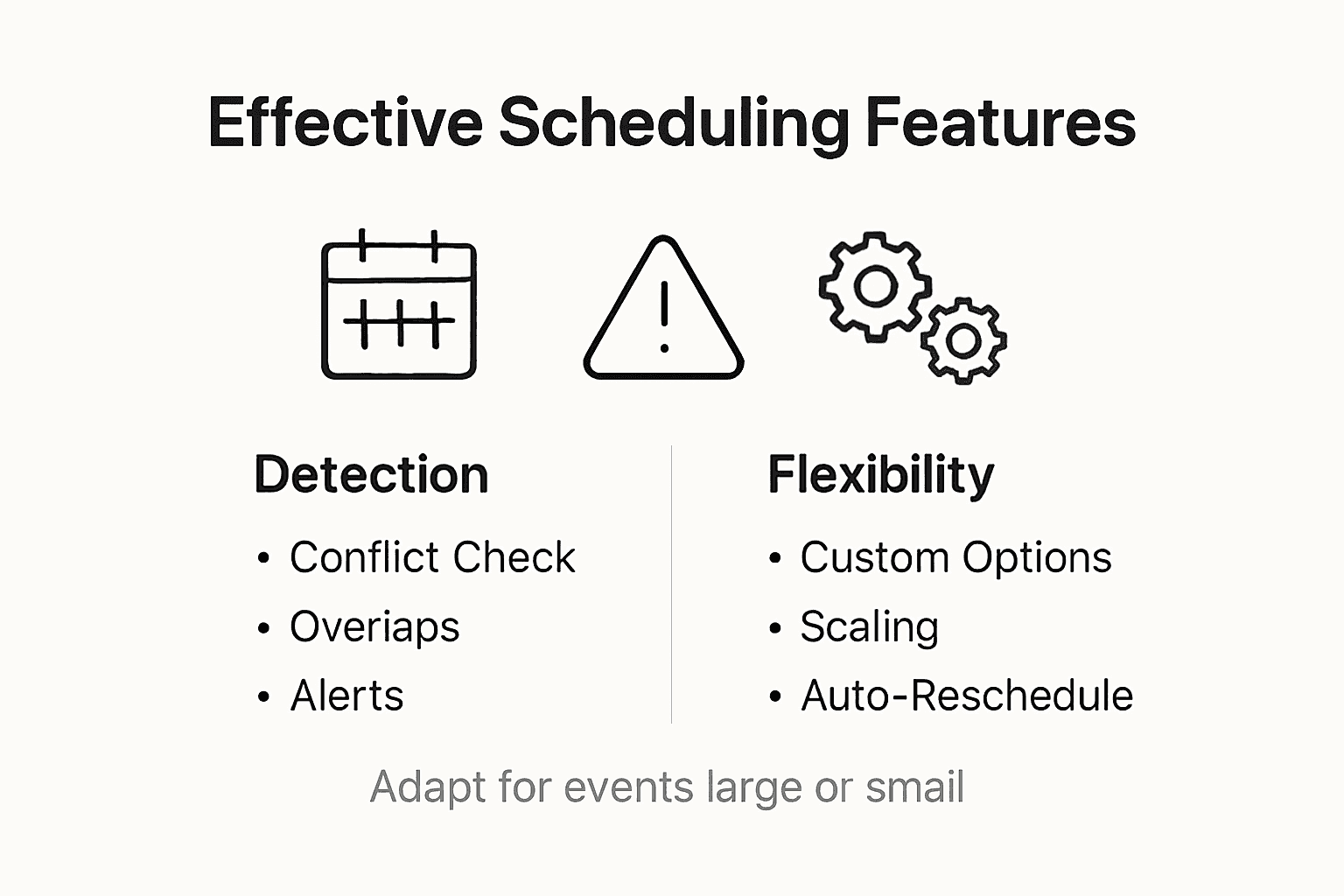
Effective scheduling systems transcend basic calendar management by incorporating sophisticated multi-objective optimization techniques. Advanced scheduling platforms leverage AI-powered algorithms to handle complex constraint management, dynamically balancing resource availability, individual preferences, and organizational requirements. These systems go beyond simple date matching, intelligently analyzing potential conflicts and proposing optimal time slots that accommodate multiple stakeholders' needs.
The core capabilities of robust scheduling tools include comprehensive conflict detection and resolution mechanisms. Multi-objective optimization models ensure balanced resource usage and stakeholder satisfaction, allowing for nuanced scheduling that considers factors like participant availability, resource constraints, and specific event requirements. These systems can automatically generate conflict-free timetables, dramatically reducing the manual effort traditionally required in coordinating group events and minimizing human error.
Scalability and adaptability represent critical features of modern scheduling systems. The most effective platforms provide flexible frameworks that can accommodate diverse scheduling scenarios—from small team meetings to large corporate retreats. They incorporate real-time feedback mechanisms, allowing continuous refinement of scheduling processes. By supporting both automated suggestions and manual adjustments, these tools strike a critical balance between technological efficiency and human decision-making flexibility.
Pro tip: Select a scheduling system that offers granular customization options and supports both automated recommendations and manual override capabilities to maximize scheduling precision.
Common Pitfalls and How to Avoid Them
Group event scheduling is fraught with potential challenges that can derail even the most carefully planned gatherings. Identifying and mitigating scheduling biases requires comprehensive planning and strategic foresight, particularly when coordinating events with multiple participants. The most prevalent pitfalls include overcommitment, poor schedule visibility, and inadequate communication strategies that create cascading coordination problems.
One of the most critical scheduling mistakes involves failing to account for individual participant constraints and preferences. Effective scheduling demands robust communication protocols and proactive conflict management, which means going beyond simple availability checks. This involves understanding not just when participants are technically free, but also considering factors like travel time, preparation requirements, potential personal obligations, and energy levels that might impact engagement. Successful event planners recognize that true scheduling effectiveness requires a holistic view of participant availability.
Technological solutions play a crucial role in avoiding scheduling pitfalls. Modern scheduling tools can help mitigate common errors by providing real-time visibility, automated conflict detection, and flexible adjustment capabilities. These systems allow event organizers to map complex scheduling landscapes, identifying potential conflicts before they become problematic. By incorporating buffer times, enabling easy rescheduling, and supporting transparent communication, advanced scheduling platforms transform what was once a logistical nightmare into a streamlined, user-friendly process.
Pro tip: Always collect unavailability data from participants first and build your scheduling strategy around their existing commitments, not the other way around.
Comparing Traditional and Inverse Scheduling
Traditional scheduling approaches operate on rigid, preset parameters that assign fixed time slots and resources based on initial availability. Mathematical programming techniques reveal significant limitations in these conventional methods, particularly when dealing with complex, dynamic environments. In traditional scheduling, planners typically start by identifying available time slots and matching participants, which often leads to compromise and suboptimal event coordination.

Inverse scheduling represents a revolutionary approach that fundamentally reframes the scheduling paradigm. Optimization techniques enable dynamic parameter modification to achieve more flexible and efficient scheduling outcomes. Instead of forcing participants to fit into predetermined slots, inverse scheduling focuses on understanding individual unavailability windows. This method allows for more nuanced scheduling by identifying precise time windows where all participants can genuinely engage, dramatically reducing conflicts and improving overall event coordination effectiveness.
The key differentiator between traditional and inverse scheduling lies in their underlying philosophies. Traditional methods assume a static scheduling landscape, while inverse scheduling acknowledges the fluid, complex nature of participant availability. By leveraging advanced algorithms and AI-driven insights, inverse scheduling can dynamically adjust schedules, incorporate real-time changes, and provide a more intelligent approach to group event planning. This approach minimizes manual coordination efforts, reduces communication overhead, and creates a more user-friendly scheduling experience that respects individual constraints and preferences.
The following table compares traditional and inverse scheduling approaches:
| Characteristic | Traditional Scheduling | Inverse Scheduling |
|---|---|---|
| Focus | Fixed time slot matching | Participant unavailability mapping |
| Adaptability | Low, rigid parameters | High, dynamic adjustments |
| Conflict Prevention | Reactive, after the fact | Proactive, before conflicts arise |
| Coordination Efficiency | Time-consuming manual effort | Automated and streamlined process |
Pro tip: When transitioning from traditional to inverse scheduling, prioritize collecting comprehensive unavailability data to maximize scheduling precision and participant satisfaction.
Simplify Your Group Event Planning with Conflict-Free Scheduling
Scheduling conflicts create stress, wasted time, and frustration when coordinating group events. This article highlights how understanding participant unavailability through inverse scheduling can prevent double bookings, overlooked commitments, and overlapping events. If you are seeking a streamlined way to avoid scheduling chaos and maximize group participation, it is time to consider solutions designed for these exact challenges.
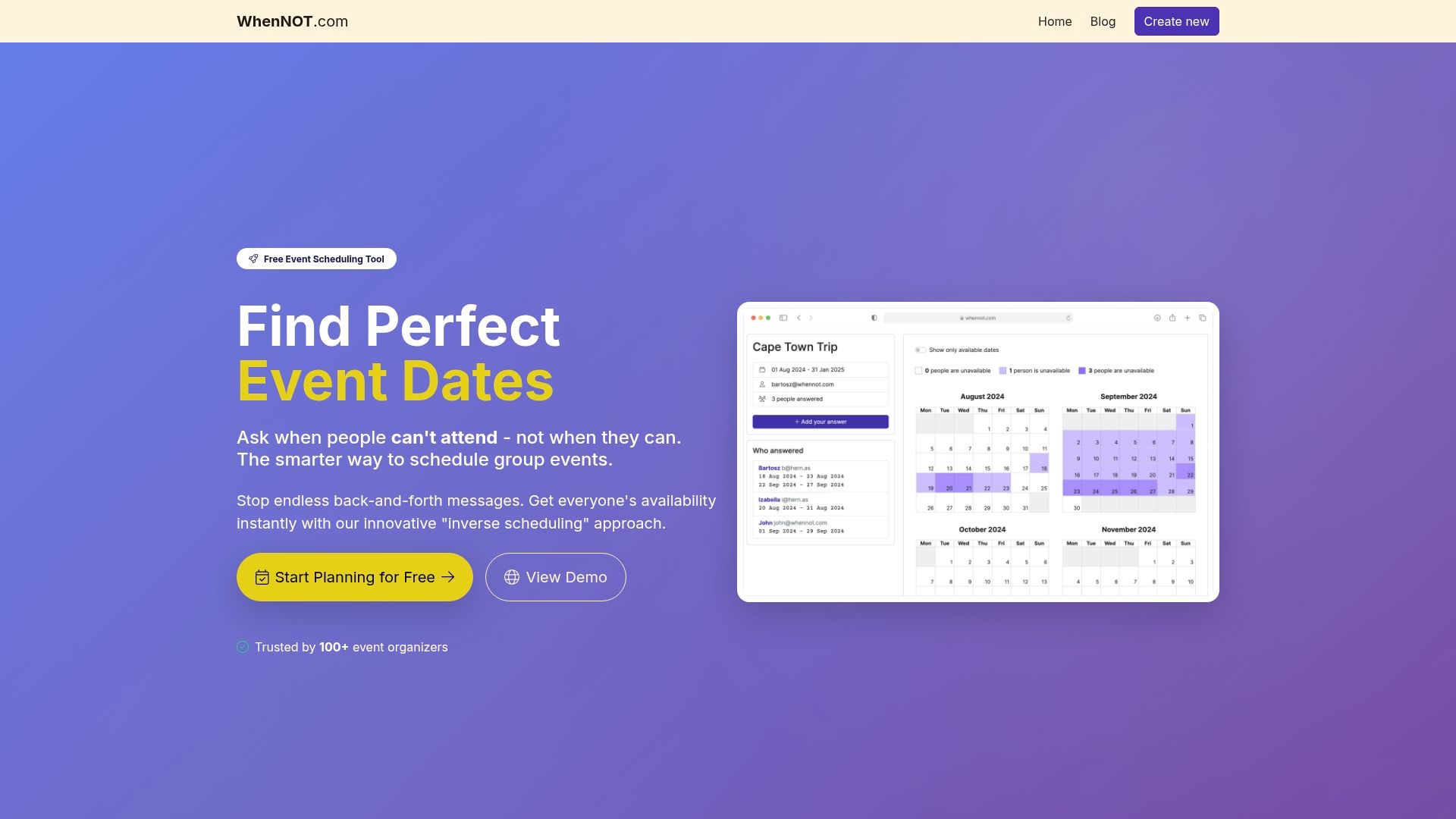
WhenNOT employs exactly this concept by asking your participants when they are not available instead of when they are free. This approach eliminates confusion, reduces the endless back-and-forth communication, and visually aligns everyone's busy days so you can immediately identify the best dates. Whether you are organizing a family reunion, corporate retreat, or complex multi-day event, WhenNOT offers a free, privacy-focused platform that makes scheduling faster and far less stressful.
Discover how inverse scheduling works to proactively prevent conflicts and start using WhenNOT today for effortless group event success.
Frequently Asked Questions
What is conflict-free scheduling?
Conflict-free scheduling is an approach that coordinates group events and tasks to prevent overlapping commitments and resource constraints. It aims to ensure seamless coordination by analyzing participant availability and predicting potential scheduling conflicts before they arise.
How do inverse scheduling tools work?
Inverse scheduling tools collect data on participant unavailability and focus on identifying optimal time slots when everyone is free. They utilize advanced algorithms and AI to dynamically adjust schedules and minimize conflicts, making group scheduling more efficient.
What are common scheduling conflicts that can occur during event planning?
Common scheduling conflicts include double booking (assigning the same resource to multiple tasks), scheduling unavailable participants, overlapping events, and an unbalanced workload distribution among team members. These issues can disrupt coordination and lead to stress or missed deadlines.
What features should I look for in an effective scheduling system?
An effective scheduling system should include conflict detection and resolution capabilities, multi-objective optimization techniques, flexibility for diverse scenarios, and real-time feedback mechanisms. It should also support both automated recommendations and manual adjustments to ensure precise scheduling.