
Nearly three out of five American event coordinators report losing valuable time to missed invitations and unclear scheduling. Organizing a successful corporate retreat or team-building event means juggling dozens of moving parts while aiming for maximum attendee participation. This article breaks down proven steps for setting objectives, choosing powerful scheduling tools, crafting strategic invites, and tracking responses efficiently, so your group planning runs smoothly and keeps everyone in sync.
Table of Contents
- Step 1: Define Event Objectives And Participant List
- Step 2: Select Optimal Scheduling Tools And Methods
- Step 3: Craft Clear And Compelling Invitations
- Step 4: Distribute Invitations And Track Responses
- Step 5: Confirm Attendance And Finalize Event Details
Quick Summary
| Key Point | Explanation |
|---|---|
| 1. Define clear event objectives | Establish specific and measurable goals using the SMART framework to guide your event planning process. |
| 2. Choose effective scheduling tools | Select scheduling platforms with features like real-time collaboration and conflict detection to simplify coordination. |
| 3. Personalize invitations purposefully | Craft engaging invitations that highlight event significance and facilitate easy RSVP processes for participants. |
| 4. Implement systematic RSVP tracking | Use a digital tool to manage responses and follow up with non-respondents to ensure desired attendance. |
| 5. Confirm attendance with detailed information | Send comprehensive confirmation emails to clarify logistics and participant expectations before the event starts. |
Step 1: Define event objectives and participant list
Setting clear event objectives is the strategic foundation for successful group planning. Before diving into logistics, you need to articulate precisely what you want to achieve and identify who needs to be involved. Effective planning requires defining measurable goals that specify desired outcomes and participant roles.
Start by gathering key stakeholders and conducting a collaborative discussion to outline your event's primary purpose. Are you organizing a corporate team building retreat, a professional conference, or a strategic planning session? Your objectives might range from knowledge sharing and skill development to networking and relationship building. Break down these objectives using the SMART framework: make them Specific, Measurable, Achievable, Relevant, and Time bound. This approach ensures that every participant understands the event's core mission and can contribute meaningfully.
Next, develop a comprehensive participant list by mapping your objectives to potential attendees. Consider roles, departments, expertise levels, and individual contributions that align with your event goals. Prioritize participants who can directly impact or benefit from the event's objectives. This targeted approach helps create a focused and impactful gathering.
Pro tip: Create a flexible participant tracking spreadsheet that allows you to easily add, remove, or categorize potential attendees as your planning evolves.
Step 2: Select optimal scheduling tools and methods
Choosing the right scheduling tools can make or break your group event planning process. Modern technology offers increasingly sophisticated solutions that can dramatically simplify coordination and reduce communication challenges. Advanced AI-based scheduling technologies help optimize resource allocation and participant preferences by providing flexible and intelligent planning capabilities.
When evaluating scheduling tools, consider several critical factors. Look for platforms that offer intuitive interfaces, real-time collaboration features, and the ability to handle complex scheduling requirements. Optimization techniques using multi-objective algorithms can significantly improve scheduling efficiency, allowing you to balance multiple priorities like participant availability, resource constraints, and strategic objectives. Prioritize tools that provide visual scheduling interfaces, automated conflict detection, and easy sharing mechanisms to streamline group coordination.
Research different scheduling solutions that align with your specific event needs. Some tools specialize in corporate retreats, while others work better for academic conferences or social gatherings. Pay attention to features like timezone management, participant invitation tracking, and integration capabilities with other planning software. The goal is to find a tool that reduces administrative overhead and makes scheduling feel effortless.
Pro tip: Test multiple scheduling tools with a small group pilot before committing to ensure the platform meets your specific coordination requirements.
Here's how different event scheduling tool features can impact group planning:
| Feature | Business Impact | Typical Use Case |
|---|---|---|
| Real-time collaboration | Faster decision-making | Remote team meetings |
| Automated conflict detection | Reduces double bookings | Multi-track conferences |
| Timezone management | Simplifies global coordination | International workshops |
| RSVP integration | Streamlines participant management | Large-scale seminars |
| Visual scheduling interface | Eases complex session mapping | Academic symposiums |
| Resource allocation optimization | Minimizes wasted resources | Onsite retreats |
Step 3: Craft clear and compelling invitations
Creating an effective event invitation requires strategic communication that captures attention and drives action. Professional invitation design involves carefully balancing critical information with engaging language, ensuring recipients understand the event's value and feel motivated to participate.

Start by developing a crystal clear subject line and opening that immediately communicates the event's purpose and significance. Include essential details like date, time, location, and any specific requirements or expectations. Effective invitation emails should provide precise logistical information while maintaining an engaging tone that resonates with your target audience. Personalize the invitation by addressing recipients directly and highlighting how the event connects to their professional interests or organizational goals. Craft a compelling narrative that explains why their participation matters and what unique value they will gain.
Ensure your invitation includes a straightforward registration or RSVP process. Make it simple for participants to confirm their attendance by providing clear instructions, contact information, and any necessary registration links. Consider including options for different participation formats like in person or virtual attendance to maximize flexibility and potential engagement.
Pro tip: Create a templated invitation format you can quickly customize for different events to maintain consistency and save preparation time.
Step 4: Distribute invitations and track responses
Successful event planning hinges on effective invitation distribution and response tracking. Implementing integrated invitation management systems enables comprehensive participant communication and real time response monitoring, helping you stay organized and responsive throughout the planning process.
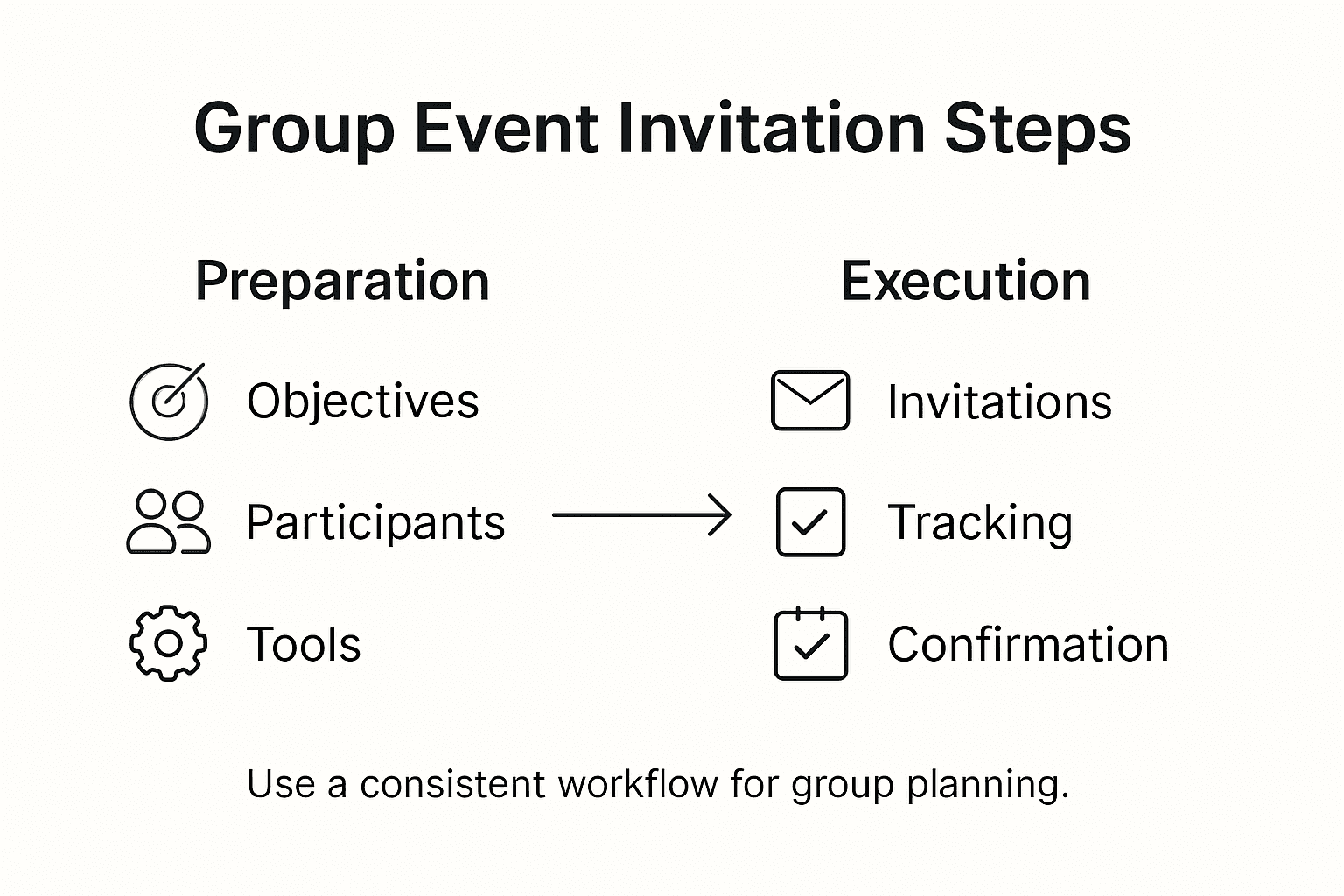
Choose a distribution method that matches your participant group and event complexity. Digital platforms offer multiple channels for sending invitations including email, messaging apps, and specialized event management systems. Advanced RSVP platforms provide customizable invitation forms with integrated tracking capabilities, allowing you to collect detailed participant information and monitor attendance in one centralized dashboard. Consider using platforms that generate unique tracking links, enable automated reminders, and provide instant response notifications to streamline your communication workflow.
Set up a systematic approach to managing participant responses. Create a spreadsheet or use a digital tracking tool to record RSVPs, track confirmations, and monitor any pending invitations. Follow up personally with key stakeholders who have not responded and be prepared to send gentle reminder communications. Include clear instructions for responding and provide multiple contact methods to accommodate different participant preferences.
Pro tip: Designate a specific team member to manage invitation tracking and follow up communications to ensure no potential participant falls through the communication cracks.
The following table summarizes key actions for successful event invitation management:
| Step | Purpose | Potential Pitfall |
|---|---|---|
| Distribute invitations | Maximize awareness | Overlooking some invitees |
| Track responses | Monitor engagement | Missed RSVPs |
| Follow up with non-respondents | Ensure desired attendance | Delayed confirmation |
| Use automated reminders | Maintain high response rate | Participant email overload |
| Centralize participant information | Enable efficient planning | Fragmented communication |
Step 5: Confirm attendance and finalize event details
Confirming attendee participation is the critical bridge between invitation and actual event execution. Professional confirmation emails play a crucial role in solidifying attendee commitment and conveying essential event information, ensuring everyone has a clear understanding of what to expect.
Craft comprehensive confirmation communications that go beyond a simple acknowledgment. Use professionally designed email templates that capture all necessary participant details including specific logistical requirements. Include precise information such as exact event time, location details, recommended arrival procedures, parking instructions, and any special preparation needed. Break down the agenda highlights to help participants understand the event structure and their expected involvement. Request additional critical information like dietary preferences, accessibility needs, or preferred session tracks to demonstrate your commitment to personalized participant experience.
Implement a systematic verification process to track and manage confirmed attendees. Create a centralized tracking system that allows you to monitor responses, follow up with pending invitees, and make real time adjustments to your event planning. Maintain open communication channels and be responsive to participant questions or special requests that might arise during the confirmation phase.
Pro tip: Create a standardized confirmation workflow with automated follow up sequences to ensure no participant communication falls through the cracks.
Simplify Your Event Invitation and Scheduling Process Today
Organizing group events often means facing the challenge of coordinating multiple schedules and managing invitations effectively. As the article "Essential Event Invitation Tips for Seamless Group Planning" highlights, tracking responses, avoiding scheduling conflicts, and ensuring clear communication are critical yet time-consuming tasks. These pain points can lead to frustration, delays, and missed opportunities for successful gatherings.
WhenNOT offers a revolutionary approach with its inverse scheduling tool that addresses these exact challenges. Instead of asking participants when they are available, WhenNOT asks them when they are not busy, simplifying complex scheduling especially for multi-day or flexible date events. This innovative method streamlines invitation tracking and response management by visualizing everyone’s busy times concurrently without requiring participants to create accounts.
Discover how WhenNOT can transform your event planning by saving valuable time, reducing communication delays, and ensuring maximum attendance. Take control now by using the tool designed to make group scheduling effortless at WhenNOT online scheduling.
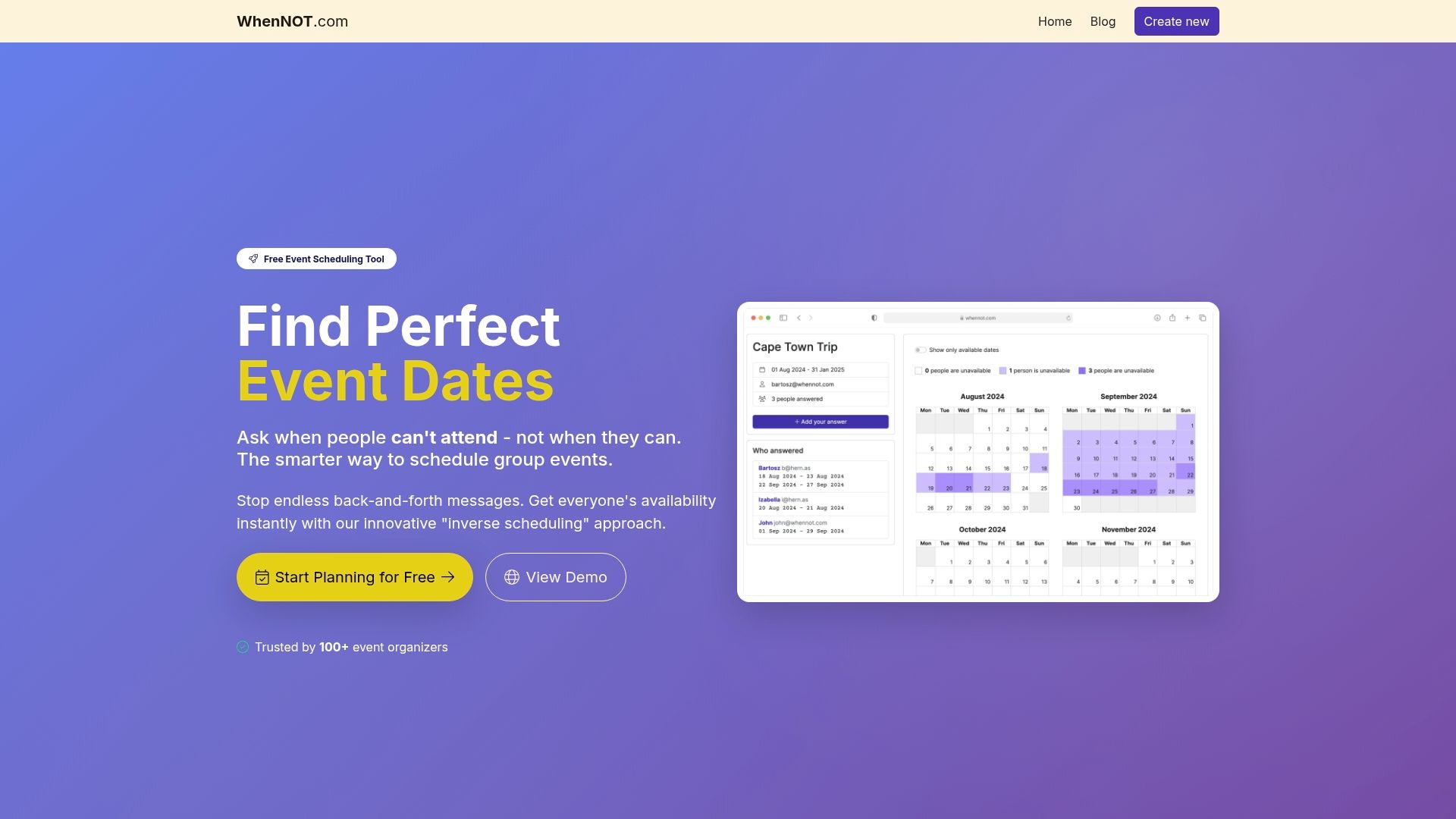
Stop juggling endless emails and conflicting calendars. Experience the convenience and efficiency of WhenNOT today and turn your event invitation and scheduling process into a seamless workflow.
Frequently Asked Questions
How do I define clear objectives for my event?
To define clear objectives for your event, gather key stakeholders and identify the primary purpose of the gathering. Break down these objectives using the SMART framework to ensure they are Specific, Measurable, Achievable, Relevant, and Time bound.
What should I include in my event invitations?
Your event invitations should include essential details such as the date, time, location, and a clear description of the event's purpose. Make sure to personalize the invitation and include a straightforward RSVP process to facilitate attendance confirmations.
How can I effectively track responses to my invitations?
To effectively track responses, use a centralized tracking system or digital tool that records RSVPs and monitors confirmations. Follow up with key participants who have not responded to ensure you have an accurate count of attendees.
What are the best practices for sending confirmation emails?
In your confirmation emails, include detailed information such as event timing, location, and specific logistical requirements. Personalize the communication to remind attendees of their expected involvement and any preparations they need to make.
How can I improve attendance at my event?
To improve attendance, create engaging invitations that highlight the value of the event to participants. Consider sending reminders before the event and offering options for different participation formats to cater to varying preferences.
What tools can help streamline my event planning process?
Consider using integrated invitation management or scheduling tools that allow for real-time collaboration and RSVP tracking. Look for tools that offer features like automated reminders and visual scheduling to enhance efficiency.