
Every American has faced the hassle of coordinating a meeting that should take minutes but ends up consuming hours. Whether it is family events, school projects, or remote work sessions, group scheduling friction often turns simple plans into logistical headaches. Over 60 percent of Americans say group scheduling is the most frustrating part of planning any event. Discover why these obstacles keep popping up and how practical new strategies can finally make coordination smoother for everyone involved.
Table of Contents
- Defining Group Scheduling Friction Today
- Common Causes Behind Scheduling Delays
- Impacts on Event Organization and Participation
- Strategies for Reducing Group Scheduling Friction
- Comparing Solutions: Traditional vs. Inverse Scheduling
Key Takeaways
| Point | Details |
|---|---|
| Group Scheduling Friction | Group scheduling friction arises from communication and coordination challenges that complicate event planning. This often leads to delays and increased stress for organizers. |
| Challenges Impacting Scheduling | Key contributors to scheduling issues include time conflicts, communication breakdowns, and time zone differences, which can escalate coordination complexity. |
| Technological Solutions | Implementing automated scheduling systems can streamline the coordination process and reduce back-and-forth communications. |
| Inverse Scheduling Benefits | Inverse scheduling simplifies event planning by allowing participants to mark unavailable times, reducing negotiation effort and improving efficiency. |
Defining Group Scheduling Friction Today
Group scheduling friction represents the complex set of communication and coordination challenges that emerge when multiple people attempt to align their availability for an event or meeting. At its core, this phenomenon transforms what should be a straightforward planning process into a frustrating, time-consuming exercise in negotiation and compromise.
In traditional scheduling approaches, participants often find themselves trapped in endless email chains, text message threads, and group chat conversations trying to find a mutually agreeable time. Manual communication methods in event coordination frequently lead to fragmented communication and significant scheduling conflicts, resulting in missed connections and abandoned planning efforts. These inefficient processes create substantial mental and emotional overhead for event organizers.
The core components of group scheduling friction typically include competing personal schedules, varied communication preferences, time zone differences, and individual availability constraints. Participants must navigate complex logistical puzzles, comparing calendars, accommodating work commitments, personal obligations, and unexpected life events. This intricate dance of scheduling becomes exponentially more challenging as the number of participants increases, transforming what should be a simple coordination task into a complex negotiation.
Here's a summary of the main contributors that complicate group scheduling:
| Challenge Type | Typical Example | Impact on Scheduling |
|---|---|---|
| Personal Time Conflicts | Overlapping work or family events | Reduces number of viable times |
| Communication Breakdown | Losing track in email chains | Delays agreement and responses |
| Time Zone Variations | Participants in different countries | Limits mutually workable slots |
| Unpredictable Events | Last-minute emergencies or travel | May force full rescheduling |
Pro Tip - Scheduling Simplification: Adopt a systematic approach to group scheduling by establishing clear communication channels and using tools that minimize back-and-forth interactions, allowing participants to efficiently share their constraints and preferences.
Common Causes Behind Scheduling Delays
Group scheduling delays emerge from a complex web of interconnected challenges that systematically undermine efficient event planning. These obstacles range from technological limitations to human communication complexities, creating significant friction in coordinating multiple participants' schedules.
Delays in complex service operations often occur in chains, where a single scheduling conflict can trigger subsequent disruptions, exponentially increasing coordination complexity. This domino effect means that what starts as a minor scheduling inconvenience can quickly escalate into a comprehensive planning breakdown. Participants must contend with competing professional commitments, personal obligations, and unexpected life events that constantly reshape individual availability.
Time zone differences and geographic dispersal significantly compound scheduling challenges. Travel time variations can dramatically impact activity scheduling, introducing additional layers of unpredictability. Remote teams, distributed families, and geographically separated social groups face heightened difficulties in finding mutually acceptable meeting windows. These spatial and temporal barriers transform what should be a straightforward coordination process into an intricate negotiation requiring sophisticated communication strategies.

Pro Tip - Scheduling Strategy: Establish a clear hierarchy of scheduling priorities and create buffer times between potential meeting slots to accommodate unexpected delays and individual schedule variations.
Impacts on Event Organization and Participation
Group scheduling challenges create profound ripple effects that extend far beyond simple calendar coordination, fundamentally disrupting event organization and individual participation dynamics. These complications transform what should be a straightforward planning process into a complex negotiation of personal and professional constraints.
Travel time disruptions can dramatically undermine event planning, forcing organizers to constantly recalibrate schedules and potentially causing significant participant dropout. When individuals struggle to synchronize their availability, the entire event structure becomes vulnerable, with potential cancellations or reduced engagement threatening the core purpose of gathering people together.
Organizational complexity emerges as a critical challenge, where service operation delays create cascading complications. These interruptions not only increase planning costs but also diminish the overall quality of event experiences. Participants may feel frustrated by repeated rescheduling attempts, leading to decreased motivation and commitment. The mental and emotional energy expended in navigating these scheduling obstacles can ultimately overshadow the anticipated benefits of the event itself.
Pro Tip - Participation Protection: Develop flexible scheduling protocols that prioritize participant convenience, including multiple time options and clear communication channels to minimize last-minute coordination challenges.
Strategies for Reducing Group Scheduling Friction
Addressing group scheduling challenges requires a multifaceted approach that combines technological solutions, communication strategies, and proactive planning techniques. Event organizers must develop comprehensive frameworks that anticipate and mitigate potential scheduling obstacles before they derail coordination efforts.
Automated scheduling systems represent a critical breakthrough in reducing communication delays and minimizing coordination friction. These intelligent platforms can streamline complex scheduling negotiations by providing transparent, real-time availability tracking, eliminating the endless back-and-forth communications that traditionally plague group event planning. By centralizing scheduling information and creating intuitive visualization tools, these systems dramatically simplify the coordination process.
Collaborative scheduling strategies demand a holistic approach that prioritizes participant flexibility and clear communication channels. Organizations and event planners must implement robust communication protocols that establish early expectations, create multiple scheduling options, and provide transparent mechanisms for participants to communicate their constraints. This might include utilizing inverse scheduling techniques, establishing preliminary scheduling windows, and creating structured yet adaptable planning frameworks that accommodate individual variability.
Pro Tip - Scheduling Flexibility: Design scheduling processes with built-in contingency options, allowing participants multiple pathways to engage and communicate their availability while maintaining a clear, structured approach to final decision-making.
Comparing Solutions: Traditional vs. Inverse Scheduling
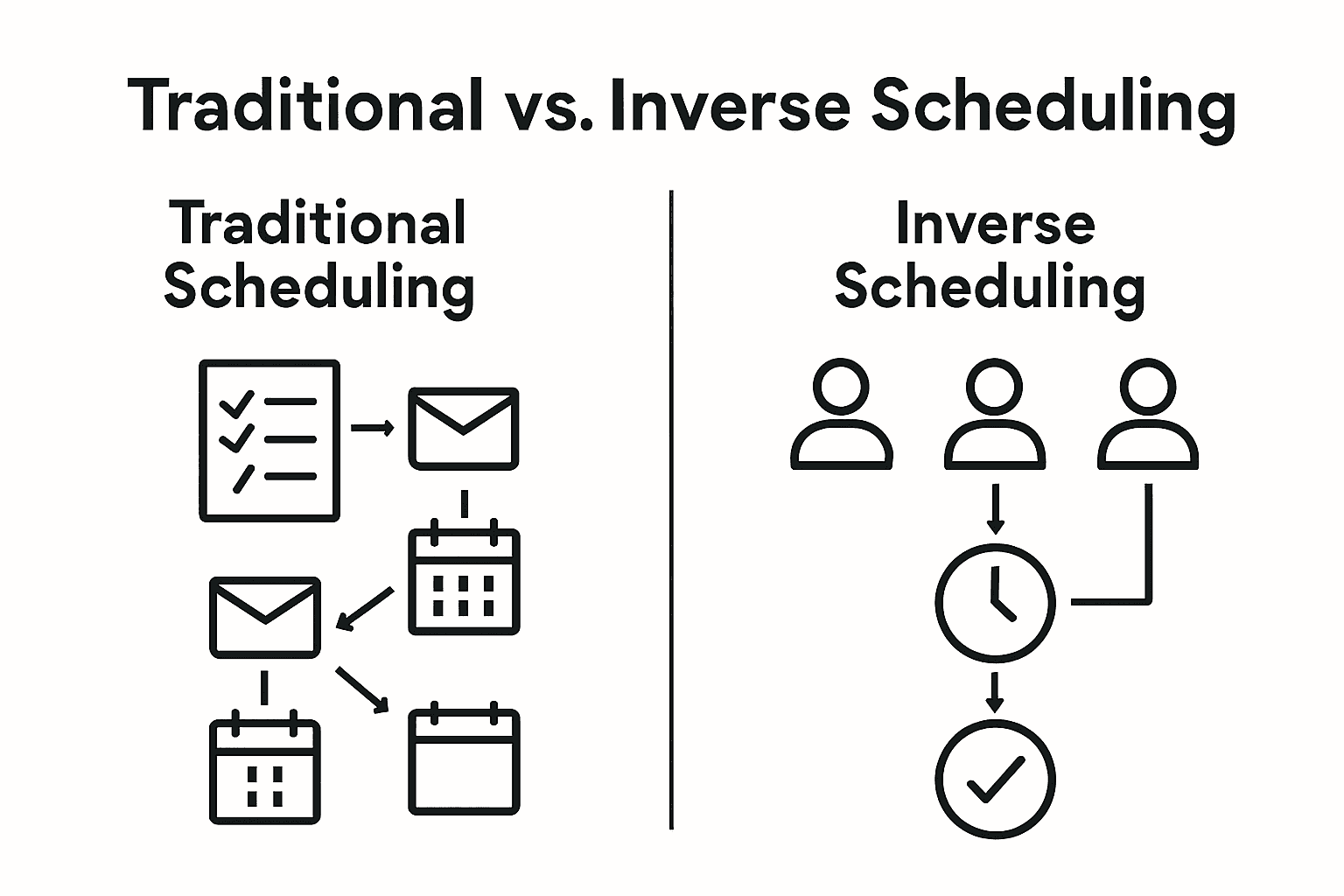
Traditional and inverse scheduling approaches represent fundamentally different strategies for managing event coordination, each with unique methodologies for addressing the complex challenge of aligning multiple participants' availabilities. Where traditional methods rely on finding mutually convenient times, inverse scheduling flips this paradigm by focusing on identifying unavailable periods.
Inverse scheduling techniques offer a revolutionary approach to dynamic event planning, enabling organizers to adjust specific scheduling parameters without disrupting the overall coordination sequence. Unlike traditional methods that require participants to manually list their available times, inverse scheduling allows individuals to quickly mark their unavailable periods, dramatically simplifying the coordination process. This approach reduces cognitive load and minimizes the complex negotiation typically associated with group scheduling.
Scheduling methodologies diverge significantly in their fundamental approach. Traditional scheduling seeks optimal job sequences, whereas inverse scheduling focuses on modifying processing times within predefined boundaries. This nuanced difference means inverse scheduling can accommodate more complex, dynamic scenarios where participant constraints are fluid and multifaceted. By prioritizing flexibility and individual constraints, inverse scheduling creates a more user-friendly, adaptable framework for group event planning.
This table compares traditional and inverse scheduling approaches for group coordination:
| Method | Core Process | Main Advantage | Best Use Case |
|---|---|---|---|
| Traditional Scheduling | Each person lists available times | Familiar, widely adopted | Small local teams or static groups |
| Inverse Scheduling | Participants mark unavailable times | Reduces negotiation effort | Dynamic, large, or remote groups |
Pro Tip - Strategic Scheduling: Adopt a hybrid scheduling approach that combines elements of both traditional and inverse methods, leveraging the strengths of each technique to create a more comprehensive and participant-friendly coordination strategy.
Eliminate Group Scheduling Friction with WhenNOT
Struggling with the endless back-and-forth of coordinating multiple participants' availability can drain your energy and delay your event planning. The article highlights key challenges like fragmented communication, time zone complications, and unpredictable events that create group scheduling friction. WhenNOT addresses these pain points through its innovative inverse scheduling approach, allowing participants to simply mark when they are unavailable rather than listing available times. This significantly reduces negotiation effort and streamlines coordination, especially for multi-day or flexible-date events.
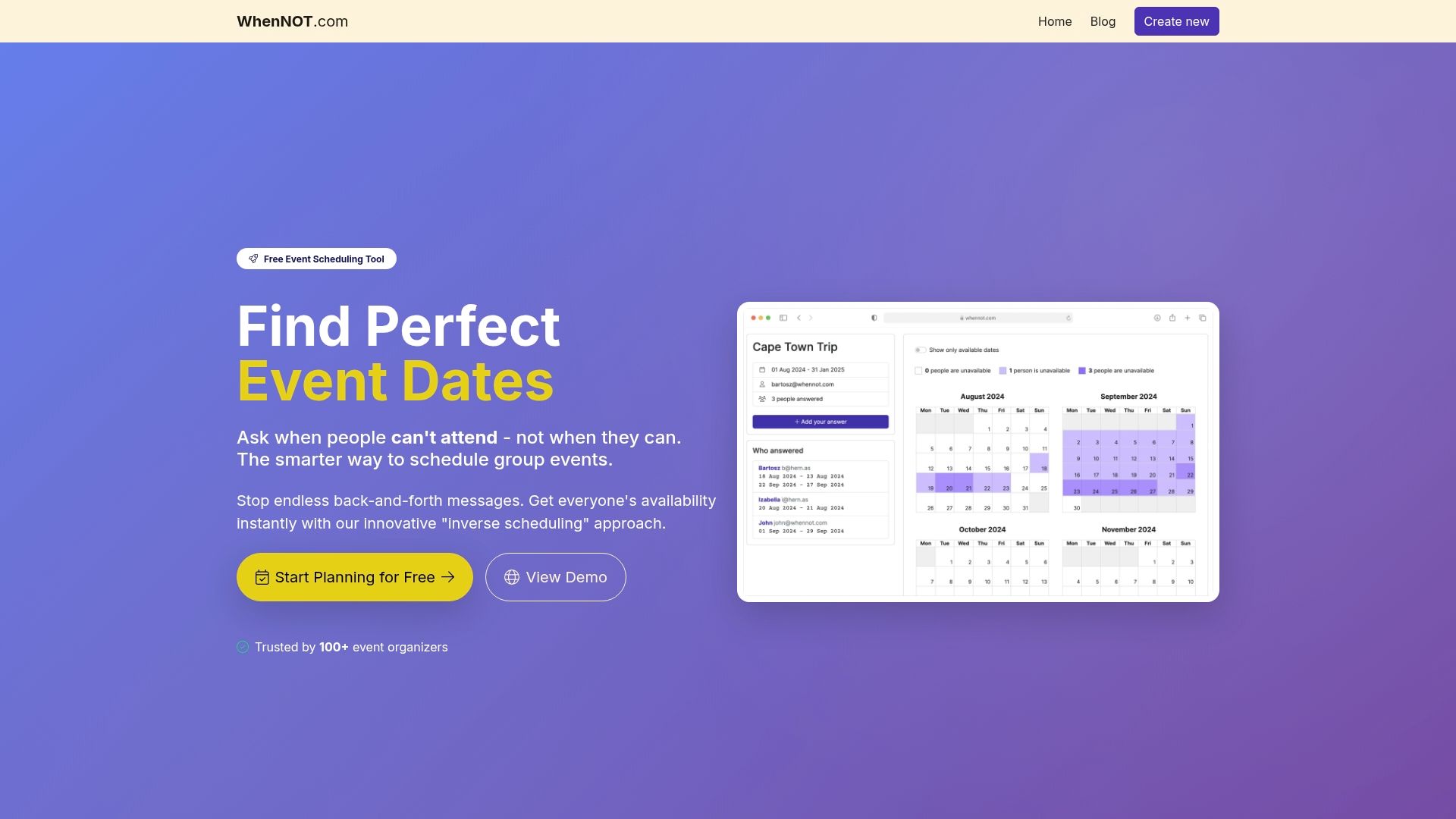
Discover how you can transform your event organization with simplicity and efficiency by using WhenNOT. Save time, minimize delays, and enjoy stress-free scheduling without needing participants to sign up. Start planning smarter today and experience the advantage of a free, privacy-focused tool designed to overcome the very group scheduling friction that slows your events. Visit WhenNOT's landing page to get started now and turn complicated scheduling into a seamless process.
Frequently Asked Questions
What is group scheduling friction?
Group scheduling friction refers to the challenges that occur when multiple people try to align their availability for an event or meeting, leading to inefficient communication and coordination processes.
What are the common causes of scheduling delays in group events?
Common causes of scheduling delays include competing personal schedules, communication breakdowns, time zone differences, and unpredictable life events that complicate aligning participants' availabilities.
How can automated scheduling systems help reduce scheduling friction?
Automated scheduling systems streamline the coordination process by providing real-time availability tracking and minimizing the need for back-and-forth communications, making it easier to find mutually agreeable meeting times.
What is the difference between traditional scheduling and inverse scheduling?
Traditional scheduling focuses on finding mutually convenient times for participants, while inverse scheduling allows participants to mark their unavailable periods, simplifying the coordination process and reducing negotiation efforts.