
Nearly 60 percent of American corporate event planners say inefficient scheduling drains valuable hours from their workweek. With global teams spanning multiple time zones and diverse constraints, organizing multi-day meetings and retreats becomes a puzzle that demands smart solutions. This article explores how feedback-driven scheduling methods cut coordination time, improve group participation, and give planners a clearer path to successful events no matter the location.
Table of Contents
- Defining Feedback's Role In Scheduling Success
- Types Of Feedback: Formal, Informal, Real-Time
- How Feedback Improves Group Event Planning
- Integrating Feedback With Scheduling Technologies
- Common Mistakes And Effective Implementation Strategies
Key Takeaways
| Point | Details |
|---|---|
| Role of Feedback | Feedback transforms group scheduling into a collaborative process that clarifies participant constraints and preferences. |
| Types of Feedback | Utilize a mix of formal, informal, and real-time feedback to enhance scheduling efficiency and responsiveness. |
| Feedback Integration | Leverage technology to streamline feedback collection, enabling real-time updates and improved coordination. |
| Common Mistakes | Avoid rigid scheduling processes by incorporating participant perspectives and using adaptive communication strategies. |
Defining Feedback's Role in Scheduling Success
Feedback plays a pivotal role in transforming group event scheduling from a complex logistical challenge to a streamlined, collaborative process. At its core, feedback represents an information exchange mechanism that enables participants to communicate constraints, preferences, and availability with unprecedented clarity. Conceptual research on feedback mechanisms reveals that effective feedback transcends simple communication—it acts as a performance optimization tool.
In group scheduling contexts, feedback functions as a dynamic information network where each participant contributes critical data points about their potential participation. Traditional scheduling approaches often relied on rigid, top-down communication models, whereas modern techniques recognize feedback as a collaborative, iterative process. Contemporary feedback models demonstrate how interactive input mechanisms can dramatically improve group coordination efficiency by allowing real-time adjustments and mutual understanding.
The strategic value of feedback in scheduling lies in its ability to surface potential conflicts, identify optimal time windows, and create shared visibility into collective availability. By enabling participants to communicate unavailability transparently, feedback transforms scheduling from a guessing game into a precise, data-driven negotiation. Organizations can leverage this approach to reduce communication overhead, minimize scheduling conflicts, and create more inclusive event planning processes that respect individual constraints while achieving collective goals.
Pro tip: Implement a structured feedback collection process that allows participants to share unavailability with minimal friction, prioritizing simplicity and user experience.
Types of Feedback: Formal, Informal, Real-Time
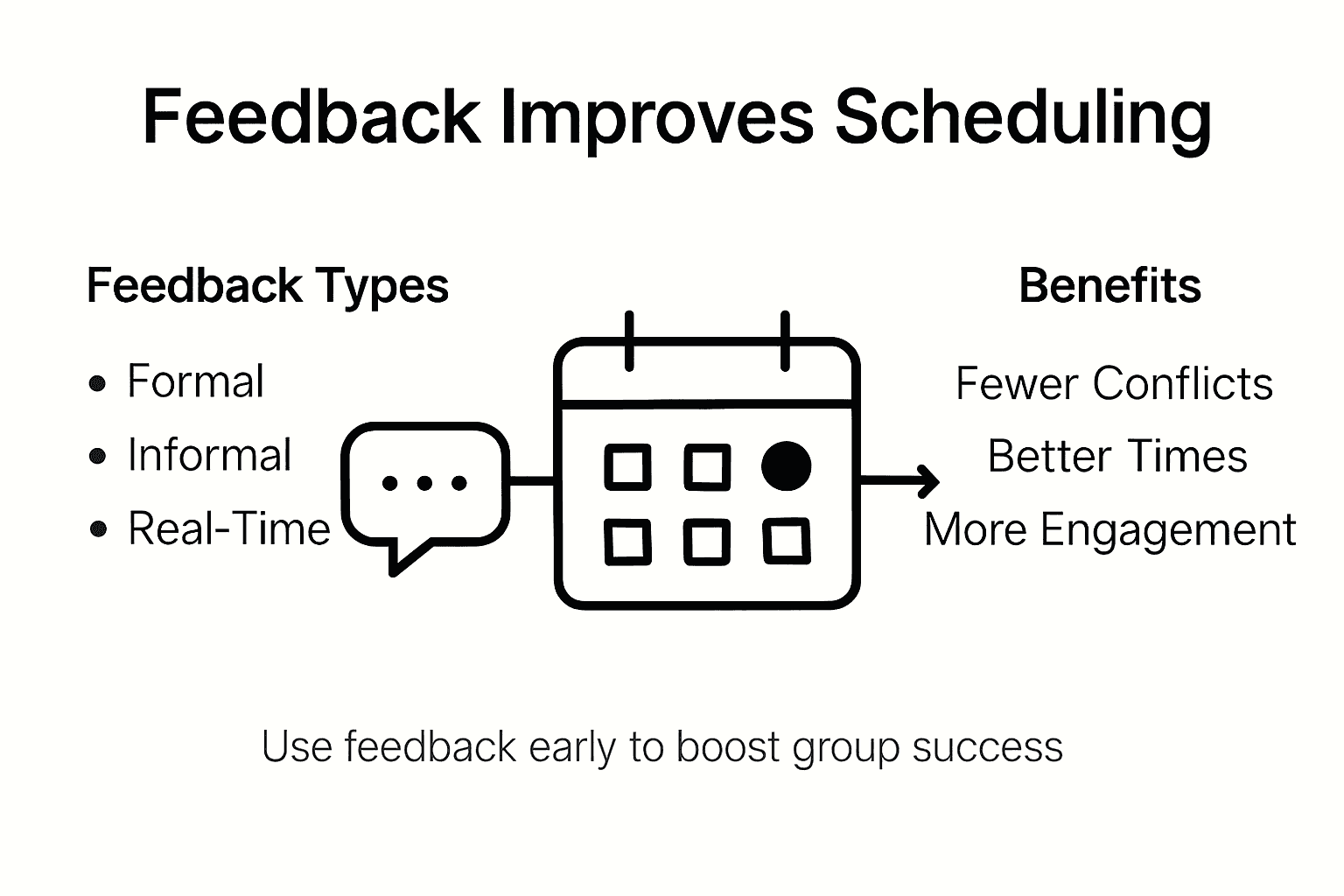
Formal feedback represents a structured, systematic approach to information exchange in scheduling processes, characterized by predetermined protocols and intentional communication strategies. Comprehensive research on feedback typologies reveals that formal feedback follows specific guidelines, involves pre-established channels, and typically includes documented interactions that create clear accountability and transparency for group event planning.
In contrast, informal feedback emerges spontaneously through casual interactions, providing real-time insights that formal mechanisms might miss. Comparative feedback analysis demonstrates that informal feedback allows participants to share nuanced preferences, unexpected constraints, and contextual details that structured formats cannot capture. This approach enables more dynamic and responsive scheduling processes, particularly in complex group environments where individual circumstances frequently shift.
The evolution of real-time feedback represents a critical advancement in scheduling technology, bridging the gap between formal documentation and spontaneous communication. Digital platforms now enable instantaneous input, allowing participants to update availability, communicate changes, and collaborate more efficiently than traditional methods. Real-time feedback transforms scheduling from a static, sequential process into a fluid, interactive negotiation that respects individual schedules while pursuing collective objectives.
Pro tip: Implement a hybrid feedback approach that combines structured formal channels with flexible real-time communication mechanisms to maximize scheduling efficiency.
Here's how the main types of scheduling feedback compare:
| Feedback Type | Structure Level | Typical Examples | Best Use Case |
|---|---|---|---|
| Formal | Highly structured | Surveys, official forms | Large events, record keeping |
| Informal | Low structure | Chats, verbal updates | Quick adjustments, small groups |
| Real-Time | Dynamic and instant | Live polls, status updates | Rapid decisions, virtual meetings |
How Feedback Improves Group Event Planning
Comprehensive feedback mechanisms transform group event planning from a guessing game into a strategic, data-driven process. By systematically collecting and analyzing participant input, event organizers can uncover critical insights that dramatically improve planning precision, participant engagement, and overall event success. This approach goes beyond traditional planning methods, creating a dynamic feedback loop that continuously refines and optimizes event experiences.

The strategic value of feedback becomes particularly evident in its ability to address potential challenges before they emerge. Event evaluation techniques enable organizers to gather both quantitative and qualitative insights from multiple stakeholders, including participants, speakers, and support staff. These multi-perspective inputs help identify potential scheduling conflicts, logistical challenges, and participant preferences that might otherwise go unnoticed, allowing for proactive adjustments and more tailored event experiences.
Feedback's most powerful role lies in its iterative nature. Each piece of input becomes a building block for future improvements, creating a cumulative knowledge base that enhances event planning sophistication over time. By treating feedback as a strategic asset rather than a mere post-event formality, organizations can develop increasingly precise scheduling strategies that balance individual needs with collective objectives. This approach transforms event planning from a rigid, top-down process into a collaborative, responsive framework that prioritizes participant experience and organizational efficiency.
Pro tip: Develop a standardized feedback collection template that captures both quantitative ratings and qualitative insights to maximize the strategic value of participant input.
Integrating Feedback With Scheduling Technologies
Technology-enhanced feedback systems represent a transformative approach to group event scheduling, enabling unprecedented levels of coordination and communication. These advanced digital platforms leverage automated tools, real-time analytics, and intelligent processing capabilities to streamline feedback collection and integration, fundamentally reimagining how organizations coordinate complex scheduling requirements. By translating participant inputs into actionable insights, these technologies create a more responsive and adaptive scheduling ecosystem.
The emergence of intelligent feedback technologies marks a significant leap forward in scheduling management. Machine learning-powered feedback mechanisms now offer sophisticated capabilities that dynamically adjust to participant needs, analyze communication patterns, and predict potential scheduling conflicts before they emerge. These systems go beyond traditional feedback collection, using advanced algorithms to understand contextual nuances, participant preferences, and organizational constraints, thus enabling more precise and personalized event coordination.
Successful integration of feedback technologies requires a strategic approach that balances technological capability with human-centered design. Organizations must view these tools not as replacements for human interaction, but as sophisticated augmentation platforms that enhance communication, reduce administrative overhead, and create more inclusive scheduling processes. By embracing these technologies, event planners can transform scheduling from a logistical challenge into a collaborative, data-driven experience that respects individual constraints while achieving collective objectives.
Pro tip: Select scheduling technologies that offer flexible, multi-modal feedback options and robust analytics capabilities to maximize participation and insights.
Key scheduling technology features and their benefits:
| Feature | How It Works | Scheduling Benefit |
|---|---|---|
| Automated Reminders | Sends emails or notifications | Reduces no-shows and confusion |
| Conflict Detection | Analyzes overlapping inputs | Minimizes double booking issues |
| Multi-Modal Feedback | Accepts input via different channels | Boosts participation and inclusivity |
| Analytics Dashboard | Displays data trends and patterns | Improves future planning accuracy |
Common Mistakes and Effective Implementation Strategies
Key challenges in feedback delivery often stem from systemic communication failures that undermine group scheduling effectiveness. Organizations frequently encounter critical errors such as inconsistent messaging, lack of clear communication channels, and poorly timed feedback mechanisms that create confusion and reduce participant engagement. Understanding these fundamental pitfalls is the first step toward developing more robust and responsive scheduling approaches that genuinely meet participant needs.
Traditional scheduling processes frequently suffer from rigid, inflexible approaches that neglect stakeholder perspectives. Strategic scheduling techniques emphasize the importance of creating adaptable frameworks that prioritize collaborative input and technological integration. Critical mistakes include relying on manual processes, failing to map participant constraints comprehensively, and using outdated communication methods that limit real-time responsiveness. Successful implementation requires a holistic approach that balances technological capability with human-centered design principles.
Effective feedback implementation demands a multifaceted strategy that combines technological innovation with nuanced communication techniques. Organizations must develop systems that not only collect information but also interpret participant inputs intelligently, creating a dynamic scheduling ecosystem that adapts to changing requirements. This approach involves creating transparent feedback channels, establishing clear communication protocols, and leveraging digital tools that enable instantaneous, context-aware scheduling adjustments.
Pro tip: Develop a standardized feedback protocol that includes multiple input channels, clear response mechanisms, and built-in flexibility to accommodate diverse participant needs.
Boost Your Group Event Success with Streamlined Feedback and Scheduling
Navigating the complexities of group event planning requires clear, efficient feedback mechanisms that prevent scheduling conflicts and boost collaboration. This article highlights how dynamic feedback transforms scheduling from a guessing game into a data-driven negotiation, uncovering key challenges like unavailability and conflicting inputs. WhenNOT offers a powerful solution that aligns perfectly with these insights, using an innovative inverse scheduling approach that captures exactly when participants are busy rather than when they are free. This method simplifies multi-day or flexible date events by visualizing everyone's unavailable dates simultaneously, saving you time and reducing communication delays.
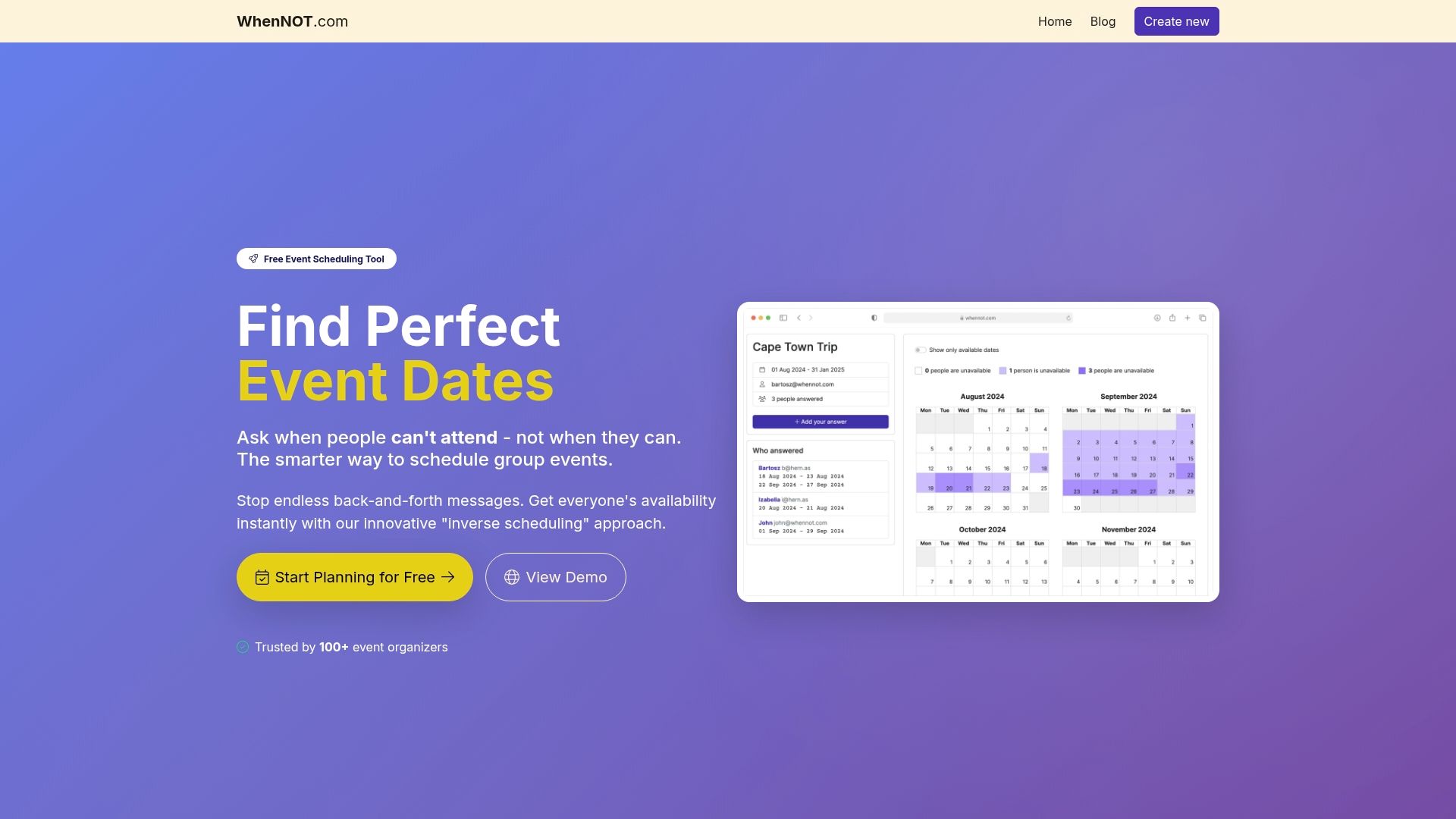
Experience an effortless way to gather precise participant input without forcing sign-ups or complicated forms. With WhenNOT, you can create events, share unique links, and watch optimal dates emerge from real-time unavailability data. Take advantage of a tool designed for privacy, simplicity, and inclusivity that transforms feedback into action. Visit WhenNOT now and turn scheduling headaches into seamless group coordination. Discover how effective feedback and innovative scheduling technology come together for outstanding event planning success.
Frequently Asked Questions
What is the role of feedback in group event scheduling?
Feedback in group event scheduling acts as a mechanism for participants to communicate their constraints, preferences, and availability clearly, transforming scheduling into a collaborative and data-driven process.
How can implementing feedback improve scheduling efficiency?
Implementing feedback helps identify scheduling conflicts, optimize time windows, and creates transparency in availability, which reduces misunderstandings and communication overhead in the scheduling process.
What are the different types of feedback in scheduling?
The main types of feedback in scheduling are formal feedback, which follows structured protocols; informal feedback, which arises from casual interactions; and real-time feedback, which enables instantaneous input for more responsive scheduling.
How can technology enhance feedback in scheduling?
Technology enhances feedback by providing automated tools and real-time analytics that streamline the collection of participant inputs, allowing for more adaptive scheduling and proactive conflict resolution.